



Tomato Hornworms: How to Spot and Stop Them

Updated November 17, 2026 · By Lauren Cain
To control tomato hornworms organically, handpick them into soapy water. Find them by following stripped leaves and dark frass pellets, or search after dark with a UV flashlight, which makes them glow. Spray Bt on small caterpillars. Leave any hornworm covered in white cocoons, because those are beneficial braconid wasps. After harvest, clear spent plants and till the soil to destroy pupae overwintering underground.
The first tomato hornworm I ever found, I didn't find. My daughter did, and the whole neighborhood heard about it. She came tearing across the yard yelling that there was a dragon on the tomatoes. I mean, she wasn't wrong. Four inches of neon-green caterpillar with a horn sticking off its back end, and somehow you can stare right at one and not see it.
So I told her what I'll tell you. It looks like a disaster. It's really just a chore.
Yes, one hornworm can take a stem down to bare sticks overnight, which is how they got their reputation. But they're slow. They're huge. They don't bite or sting, and just about every good bug in your yard is out hunting them. All you need is ten minutes, a jar of soapy water and (this is my favorite part) a flashlight.
Reading this in late fall? Here in Kansas City our tomatoes are long gone, and that's true for most of the country. If you're in the Deep South, Florida, south Texas or Southern California and your plants are still going, the plan below is for you right now. Everybody else, skip down to the end-of-season step and do it before the ground freezes (or first thing in spring). Then bookmark this for July. You'll want it.
What's in this guide
- What does a tomato hornworm look like?
- How do you find tomato hornworms?
- How to get rid of tomato hornworms organically
- Should you kill a hornworm with white cocoons?
- What eats tomato hornworms?
- How to prevent hornworms next year
- How to help a stripped tomato plant recover
- Real gardeners, real results
- Frequently asked questions
What Does a Tomato Hornworm Look Like?
A tomato hornworm is the caterpillar of a big gray moth. It's soft and fat and the exact green of a tomato stem, which feels a little unfair. Full grown, it's about four inches long and as thick as your finger.
Look along its sides and you'll see a row of pale V-shaped marks. Then there's the curved spine on its rear end, the "horn" the whole family is named for. It looks like it could hurt you. It can't.
Two names get thrown around, and they confuse people. The tomato hornworm (Manduca quinquemaculata) and the tobacco hornworm (Manduca sexta) are close cousins, and both love tomatoes. The table below shows how to tell them apart if you're curious. If you're not, don't worry about it, because you deal with both of them the exact same way.
| Feature | Tomato hornworm | Tobacco hornworm |
|---|---|---|
| Scientific name | Manduca quinquemaculata | Manduca sexta |
| Side markings | White V-shaped marks | Diagonal white stripes |
| Horn color | Dark blue or black | Red or orange-red |
| Adult moth | Five-spotted hawk moth | Carolina sphinx moth |
| Eats tomatoes? | Yes | Yes |
| Control method | Same | Same |
It all starts with the moth. If you've ever seen something the size of a hummingbird hovering over your flowers at dusk, that was probably it. The moth lays round, greenish eggs one at a time on the undersides of tomato leaves. The caterpillars hatch and eat for three or four weeks, and then each one drops to the ground and digs a few inches down to spend the winter. Remember that part. It matters later.
Plenty of northern gardens only get one round of them a summer. Where the season runs long, you might get two.
How Do You Find Tomato Hornworms?
Hornworms are ridiculously good at hiding, so you'll almost always see the damage before you see the caterpillar. What tips you off, more or less in the order you'll notice it:
- Stripped leaves, top down. They start at the top of the plant and eat their way down. If the upper stems are bare except for the center veins, that's them, and they can clear a whole branch in one night.
- Frass. That's the polite word for caterpillar poop, and it gives them away every time. Look for little dark green or black pellets on the leaves below and on the ground. Whoever left them is right above. Follow the trail up.
- Bites out of green tomatoes. When the leaves run low they start in on the fruit, leaving shallow open gouges.
- Finally, the caterpillar. Go slow and check the stems right above the frass. They freeze and stretch out along a stem so perfectly that I still look right past them two or three times.

Stripped foliage near the top of the plant is usually your first clue. Then look for frass and follow it up to the caterpillar.
Now for the trick. Go out after dark with a UV flashlight. Hornworms glow a pale greenish-white under ultraviolet light, so the caterpillar you couldn't find at noon lights up like a glow stick. A cheap blacklight from the hardware store turns a fifteen-minute hunt into a thirty-second walk down the row. I wish somebody had told me that years ago. It feels a little like cheating.
How to Get Rid of Tomato Hornworms Organically
Nothing here is harsh. You've probably got everything you need sitting in the kitchen already.
1. Handpick them (yes, by hand)
I know. But hornworms are big and there usually aren't many, so pulling them off by hand beats everything else. University of Minnesota Extension calls it the most effective method too. Go out when it's cool, morning or evening, and follow the frass. They hang on tighter than you'd expect, so use a slow, steady pull. Then drop them in a jar of soapy water.
If touching a four-inch caterpillar isn't your thing, wear a glove or use kitchen tongs. I won't tell anybody. Check your plants at least twice a week in summer. A few nights out with the flashlight is usually all it takes to clear a plant.
2. Use Bt on the little ones
If you've got a lot of small hornworms, or more tomato plants than patience, try Bt (Bacillus thuringiensis subspecies kurstaki). It's a bacterium that lives naturally in soil, it's approved for organic gardens, and it only hurts caterpillars that actually eat it. Your bees and ladybugs are fine. So are you.
The catch is that it works best on young caterpillars. Utah State says under about half an inch. Spray the tops and bottoms of the leaves as soon as you spot small ones or fresh frass. Sunlight breaks it down, so spray again every five to seven days until you stop seeing new ones.
The one-page version: Follow the frass to the hornworm. Handpick it into soapy water (a UV flashlight after dark makes it almost too easy). Spray Bt if there are lots of small ones. Spare any hornworm wearing white cocoons. At season's end, clear the plants and turn the soil to break up overwintering pupae. No harsh chemicals anywhere.
3. What to skip
Leave the big broad-spectrum sprays on the shelf. You don't need one for a bug you can spot from six feet away and pull off with two fingers. Those sprays kill the wasps and lady beetles and lacewings that are already handling this for you, and they can hang around a lot longer than you'd think (our post on how long pesticides stay in soil gets into that). With hornworms, the gentle way really is the best way. That doesn't happen often.
Should You Kill a Hornworm With White Cocoons?
No. If you only read one section, make it this one.
Sooner or later you'll find a hornworm that looks like somebody glued rice all over its back. You'll want to squash it. Please don't. That one's already working for you.
Those white grains are cocoons of a tiny wasp, the braconid wasp Cotesia congregata, and it's one of the good guys. A female wasp laid her eggs inside the caterpillar, and her babies ate it from the inside out. (Gross, I know. Nature's like that.) Then they chewed their way out and spun those little cocoons on its skin. The hornworm has pretty much stopped eating, and it's going to die. In a few days dozens of new wasps hatch out and go looking for your next batch of hornworms.

Flowers tucked among the vegetables keep beneficial wasps and other predators around, quietly hunting hornworms while you're not looking.
So, the rule. A plain green hornworm goes in the soapy water. One covered in white cocoons stays right where it is. If you can't stand seeing it on your best tomato plant, snip off the leaf it's on and set it in a far corner so the wasps can finish up. Squash it and you've traded one tidy afternoon for a bigger mess next month.
What Eats Tomato Hornworms?
The wasps get most of the credit, but they've got help. A healthy garden has a whole crew working on this:
- Lady beetles and green lacewings go after the eggs and the tiny caterpillars.
- Paper wasps carry off small caterpillars to feed their young.
- And birds. A fat green caterpillar is a pretty good lunch.
Mostly your job is to stay out of their way. Skip the broad sprays, and give the helpers a reason to stay. Little flowers like dill, fennel, yarrow, alyssum and cosmos feed the adult wasps and lacewings, plus hoverflies. Tuck a few between your tomatoes and it's basically a help-wanted sign. Our guides to attracting beneficial insects and companion planting for tomatoes show what to plant where, and natural pest control for the vegetable garden covers the rest of the cast.
How to Prevent Tomato Hornworms Next Year
This is the reason the post shows up in November. Remember those full-grown hornworms dropping off the plant? They dig about 3 to 6 inches into the soil and spend the winter there as pupae. So this year's crop of next year's moths is sitting in your beds right now. You can do something about that.
- Pull the spent tomato plants. Get the old vines out, plus whatever's lying around them. Our end-of-season garden cleanup guide covers the rest of the job.
- Turn the soil. Tilling or turning your beds in fall (or again early in spring) breaks up those pupae. Minnesota and Utah State Extension both recommend it. And since you've already got a shovel in your hand, it's a good time to amend your garden soil for fall.
- Move things around next year. If you've got the room, plant your tomatoes, peppers and eggplant somewhere new. The moths that come up in spring will have to hunt a little harder. Hornworms like peppers too, by the way, so our guide to growing peppers organically is worth a look.
- Start looking early. Once tomatoes are back in the ground, flip a few top leaves every couple of days and look for little round green eggs. Way easier to deal with one caterpillar than a bare plant.

Turning your beds at season's end destroys overwintering hornworm pupae. A short job now means fewer hornworms next summer.
While you're putting the garden to bed, our guide to common garden pests and how to identify them are good winter reading, and so is organic pest control for vegetables. If your tomato leaves looked bad this year and nothing was chewing on them, try why tomato leaves turn yellow.
How to Help a Stripped Tomato Plant Recover
Did the hornworms get there first? It happens to all of us. Tomatoes are a lot tougher than they look, and once the caterpillars are gone, most plants will leaf back out and keep ripening fruit if you give them a little help.
This is when I grab Plant Juice. But I want to be really clear about one thing. Plant Juice is a fertilizer, not a pesticide, and it won't kill a single hornworm. That's what your fingers and the flashlight are for.
What it does is feed the soil, and the soil feeds the plant. When we had it lab tested, it came back with 291 microbial species. One of them is Pseudomonas putida, at about 1.22 million cells per milliliter, and it belongs to a group known for living around plant roots. A plant that just lost half its leaves has a lot of rebuilding to do. Plant Juice is gentle enough that it won't burn a plant that's already had a rough week. I think of it as the recovery meal, not the fight. For the rest of the season, see how to fertilize tomatoes organically.

Once the hornworms are handled, a gentle organic feed helps a stripped tomato plant rebuild its leaves.
After the hornworms are gone: clear the chewed debris, keep watering steady, and feed with a diluted dose of Plant Juice to support fresh growth. A strong, well-fed plant with good bugs patrolling it is your best insurance against the next wave.
Real Gardeners, Real Results
Don't just take my word for it. These are from gardeners who've watched their own tomatoes come back.
Lauren B.
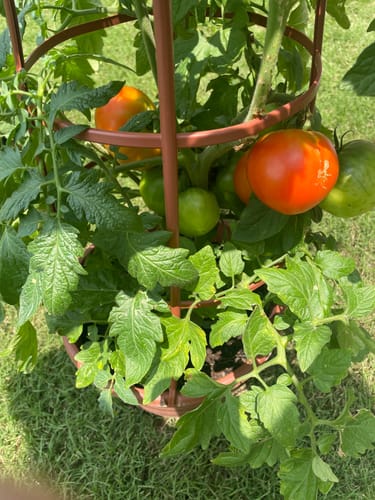
This cherry tomato plant was dying off, now I think it will produce until Thanksgiving!

Mike R.
I have been using Plant Juice on these tomato plants since I started growing them.They are really putting out .We tried one last night with dinner and it tasted like Candy. it was the best tomato I have ever eaten.
I used Bloom Juice on these flowers and they are looking awesome.
Susan M.
I have had vegetable gardens now for about 10 years. I have had pretty good success, but this year with the use of Elm dirt, the garden looks healthier than we have had, and the amount of produce has doubled. I will be using Elm Dirt annually! Very happy!

Tracy B.
I bought this because I had rescued some plants and trees from my workplace that needed some love, some extra attention and these poor plants seemed stressed. I brought them home and I began treating them with this amazing product! Within days they perked up. They began new growth previously unseen. What appeared to be plants on their last legs were nearly twice the size within a month, healthy, vibrant and full. The growth and blooms that came upon bare stalks of a barely breathing plant became full and lush. I have a neighbor who had a tropical that was struggling and I treated it and within the week it was blooming more than it ever had before. It is an amazing product and you will notice within the week of the first treatment. Unbelievable! Beyond satisfied with this product.
Rated 4.7 out of 5 across 1,793 verified Plant Juice reviews.
Frequently Asked Questions
What does a tomato hornworm look like?
A tomato hornworm is a soft, bright green caterpillar up to about four inches long, with white V-shaped marks along each side and a curved horn on its rear end. Its horn is dark blue or black. The close cousin, the tobacco hornworm, has diagonal white stripes and a red horn. Both eat tomatoes and are controlled the same way.
How do I get rid of tomato hornworms organically?
Handpick them and drop them into soapy water. Find them by following stripped leaves and dark frass pellets, or search after dark with a UV flashlight, since hornworms glow under ultraviolet light. For many small caterpillars, spray Bt (Bacillus thuringiensis subsp. kurstaki), an organic option that only affects caterpillars that eat it.
There's white "rice" on my hornworm's back. Should I kill it?
No. Leave it. The white grains are cocoons of the braconid wasp Cotesia congregata, whose larvae fed inside the hornworm, and the hornworm will soon die. When the new wasps emerge, they parasitize more hornworms for free.
When do tomato hornworms show up, and where do they go in winter?
Hornworm feeding peaks in mid-to-late summer, and each caterpillar feeds for about three to four weeks. A full-grown hornworm drops to the ground and burrows roughly 3 to 6 inches into the soil, where it spends the winter as a brown pupa. The adult five-spotted hawk moth emerges the next season, which is why tilling beds in fall or early spring helps break the cycle.
Does Bt work on tomato hornworms?
Yes, and it works best on young caterpillars. Bt kurstaki is a naturally occurring soil bacterium that only affects caterpillars that eat it, and it is safe for people, pets, and bees. Spray leaf tops and undersides when you first see small hornworms and reapply every 5 to 7 days. For large hornworms, handpicking is faster.
Will feeding my tomatoes get rid of hornworms?
No. Plant Juice is a fertilizer, not a pesticide, and it will not kill hornworms. Feeding helps a plant that lost leaves push new growth after the caterpillars are removed. Remove the hornworms first, then feed the plant.
You've Got This
Hornworms look like a crisis. They're really just a chore, and one you can win. Follow the frass and pick them off. (With the flashlight it's kind of fun, not gonna lie.) Leave the ones wearing wasp cocoons, and let the good bugs do their thing. Then turn your beds before winter and feed anything that got chewed. Next summer you'll have a lot fewer dragons on your tomatoes.
There's one thing I keep coming back to, though. When a wasp shows up out of nowhere to hunt your hornworms, or a plant you'd written off pushes out new leaves, you didn't really do that. Most of it is happening underground and around the edges of your yard, where you can't see it. A teaspoon of healthy soil holds billions of microbes, and we're still learning all the ways beneficial microbes help plants grow. You pick the caterpillars. The living soil and the good bugs take care of a lot of the rest.
If this helped, sign up for our free garden emails and get one small win in your inbox. And tell us about the biggest hornworm you ever found! The "my kid thought it was a dragon" stories are kind of the whole reason we do this. Together we grow.
Feed Your Garden the Easy Way: Shop Plant Juice
Sources: University of Minnesota Extension, Tomato hornworms in home gardens; Utah State University Extension, Tomato and Tobacco Hornworms; UMass Amherst Center for Agriculture, Food, and the Environment, Tomato Hornworm; Parker, A. L. & Kingsolver, J. G. (2024), The interactive effects of heat stress, parasitism and host plant quality in a host–parasitoid system, Functional Ecology 38: 642–653; Bredlau, J. P. et al. (2019), The parasitic wasp Cotesia congregata (Say) consists of two incipient species, Frontiers in Ecology and Evolution 7: 187.

Lauren Cain
Founder & Chemical Engineer · Elm Dirt, Kansas City
Lauren started Elm Dirt after her 6-month-old daughter grabbed fistfuls of dirt and ate them. As a chemical engineer and a mom, she couldn't just shrug it off, so she dug into the science of what was really in garden soil and built a fertilizer line around beneficial microbes instead of synthetic chemicals. Today Elm Dirt's products are used by home gardeners, rose show champions, and organic growers across the country.