



Organic Vegetable Fertilizer: What to Feed Each Vegetable and When

The short answer: the best organic fertilizer for vegetables isn't one product with one magic number on the label. It's worm castings worked into the bed for slow, steady nutrition, plus a gentle liquid feed every 2–3 weeks — and the mix shifts from nitrogen to bloom support the moment your fruiting crops flower.
Leafy greens want nitrogen the whole way through. Tomatoes, peppers, squash and cucumbers want nitrogen early and then something different once they bloom. Beans and peas want almost nothing from you at all, because they make their own.
Most of us learned to feed a vegetable garden the way our parents did, which is to say we bought a box of blue crystals, sprinkled some around, and hoped. Then late July shows up and there's this magnificent four-foot tomato plant standing in the corner of the yard with, what, three tomatoes on it? Four, if you count the one the squirrels got. All that plant, and hardly anything to show for it.
I'm Lauren — chemical engineer by training, mom by the considerably more demanding job description. I started Elm Dirt after my baby girl got a fistful of backyard dirt into her mouth before I could get across the yard to her. That sent me looking into what's actually living down in garden soil, which turned into a much longer project than I planned on, and it changed how I feed every single thing I grow.
Here's the part nobody prints on the back of the box: vegetables don't all want the same food, and they don't want it at the same time. A head of lettuce and a tomato plant have about as much in common, appetite-wise, as a toddler and a teenager. So this guide goes crop by crop — what to feed, and when — and you won't need a chemistry degree to follow it.
The quick version, if you're standing out in the garden reading this on your phone:
• Feed the soil, not just the plant. Build the bed with worm castings, then top up with a gentle liquid every 2–3 weeks.
• Leafy greens want nitrogen, steady, the whole way through.
• Fruiting crops want nitrogen early, then a real switch to bloom support the minute the first flower opens.
• Beans and peas want almost nothing. They've got bacteria in their roots doing the work already.
• When you're not sure, feed a little less a little more often. You can un-do a lot of things in a garden, but you can't un-burn a plant.
Reading this in late July? Then you're standing in the most important feeding window of the whole year, and it's the one most folks sail right past. Tomatoes, peppers, cucumbers and squash are setting and sizing fruit right now, and that's a phosphorus-and-potassium job rather than a nitrogen one. Skip ahead to flowering & fruiting if that's where you're at — or grab our summer garden fertilizer guide and mid-summer garden rescue for the whole late-season playbook.
The one rule that fixes most feeding problems
Feed the soil, not the plant. I know that sounds like something printed on a tote bag at a garden center, but it really is the whole thing.
Synthetic fertilizers are basically concentrated salt. They shove nutrients straight at the roots, hand you a fast green-up, and then they're gone — they haven't built anything that lasts past the next rain. Over enough seasons they wear down the living part of your soil, which is a big part of why some gardens seem to get needier every year instead of easier. I got into that in why we stopped using synthetic fertilizers, and there's a side-by-side comparison in organic vs. synthetic soil health if you want to see the two approaches next to each other.
Organic vegetable fertilizer works different. It feeds the bacteria and fungi already living in your dirt, and those are the ones doing the actual labor — breaking nutrients down into forms a root can grab hold of, pulling nitrogen out of thin air, elbowing the bad fungi out of the neighborhood.
You're not feeding the tomato. You're feeding the billions of microbes that feed the tomato.
I had it tested, because I didn't want to just say it
We sent Plant Juice off to an independent lab called BiomeMakers to have the whole thing DNA sequenced, and they came back with 291 verified microbial species in the bottle (that's Report CUX005, if you want the paperwork). A few of the ones pulling real weight:
- Bradyrhizobium canariense — pulls nitrogen out of the air and hands it off down at the root zone, which is a big deal for anything you're growing for its leaves.
- Rhizobium — the classic nitrogen-fixer, the one that partners up with beans and peas.
- Bacillus species — several different ones in there, earning their keep on root development and keeping soil-borne disease from getting a foothold.
- Trichoderma spirale — a fungal bodyguard. It colonizes the root zone and crowds root rot out of the space it wants.
- Pseudomonas putida — frees up phosphorus that's chemically locked into the soil where roots can't reach it, and runs disease defense on the side.
- Mortierella elongata — a fungus that stretches the reach of the root system, sort of like running extra plumbing out into the bed.
The lab didn't just count them, either. They measured what the community can actually do: 80% inorganic nitrogen release, 84% auxin production (auxin's the growth hormone that drives roots and shoots), 82% ACC deaminase, and 56% antifungal biocontrol.
That ACC deaminase number is the one I get excited about, and I realize that's a weird thing to get excited about. It's the stress-tolerance piece — it's what helps a plant hold together through a week of high heat instead of dropping everything and sulking. In a Missouri August that matters more than another point of nitrogen. If you want the deeper science, the nitrogen cycle explainer and how beneficial microbes help plants grow connect a lot of the dots. And this isn't just us saying it — extension folks have been on this for years. UC Agriculture & Natural Resources has good plain reading on soil biology, and there's peer-reviewed work on plant growth-promoting rhizobacteria backing up the nitrogen and hormone side of it.
N-P-K, in plain English
You've seen those three numbers on every bag you've ever picked up. Here's all you actually need out of them — they're the three big nutrients, and each one mostly has a single job:
- N — Nitrogen. Leaves and green growth. Think lettuce, spinach, kale.
- P — Phosphorus. Roots, flowers, fruit. This is the part of a tomato plant that actually makes tomatoes.
- K — Potassium. Sturdiness, disease resistance, and the quality of the fruit itself. It's the plant's immune system, more or less.
And now the part that took me embarrassingly long to figure out: what a vegetable needs changes as it grows.
A young tomato seedling wants nitrogen so it can build a decent frame to hang fruit on. But the day it flowers, nitrogen quietly turns into the enemy, and if you keep pouring it on you end up with a leaf monster — gorgeous, enormous, useless. That's the moment to back the N off and lean into bloom support instead. There's more on that in how to fertilize tomatoes organically and tomato plant fertilizer.
So the timing matters every bit as much as the number on the bag. Which brings us to the good part. And if you've ever stood in an aisle squinting at a label wondering what half of it even means, how to read an organic fertilizer label is worth five minutes of your life.
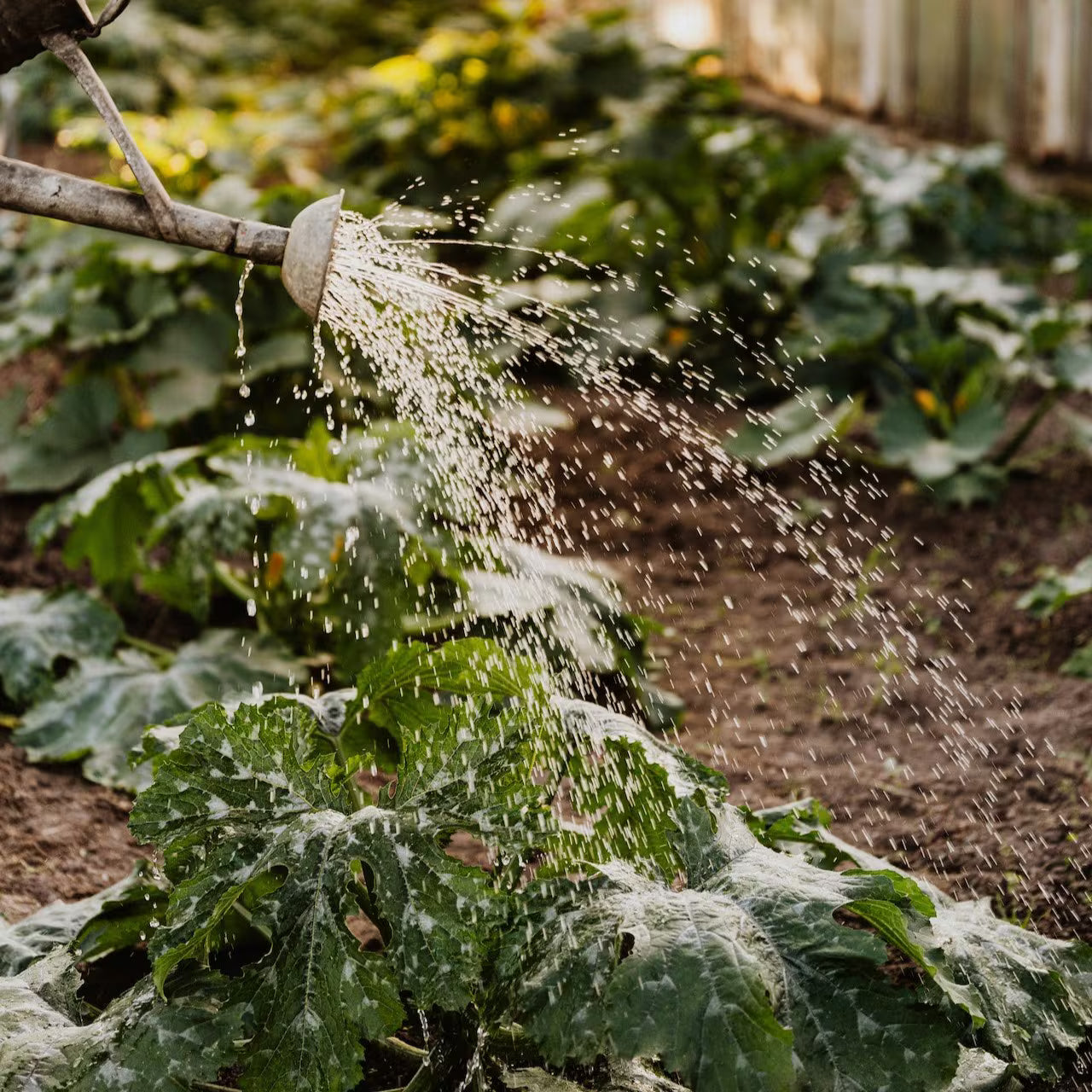
What to feed each vegetable (and when)
Here's the cheat sheet I wish somebody had handed me when I was starting out. I grouped things by how they eat rather than by plant family, because that's what actually matters when you're standing there with a watering can. Scroll it sideways on your phone to see the whole thing.
| Vegetable | Feeder type | What it wants | When to feed |
|---|---|---|---|
| Lettuce, spinach, kale, chard, arugula | Light–medium | Steady nitrogen for leaf growth | Every 2 weeks once true leaves appear; stop a few days before harvest |
| Tomatoes | Heavy | Nitrogen early, then phosphorus & potassium for fruit | Every 2 weeks; switch to bloom support at first flower |
| Peppers (sweet & hot) | Heavy | Easy on nitrogen, strong on potassium and calcium | Every 2–3 weeks; ease off the N once flowering starts |
| Cucumbers, squash, zucchini, melons | Heavy | Nitrogen for vines, then bloom support for fruit set | Every 2 weeks; bloom support when flowers open |
| Beans & peas (legumes) | Very light | Almost nothing — they fix their own nitrogen | Skip the nitrogen; a little potassium at flowering is plenty |
| Carrots, beets, radishes, turnips | Light | Phosphorus & potassium for roots; go easy on nitrogen | Work feed into the bed before planting; light feed mid-season |
| Potatoes | Medium–heavy | Balanced early, more potassium as tubers form | At planting, then again when plants are ~6 in. tall |
| Onions, garlic, leeks | Medium | Nitrogen while leaves grow, then stop before bulbing | Every 2–3 weeks early; quit feeding once bulbs swell |
| Broccoli, cabbage, cauliflower, brussels sprouts | Heavy | Steady nitrogen for big leafy heads | Every 2 weeks through the whole season |
| Corn | Very heavy | Lots of nitrogen — it's a grass and it's hungry | At planting, knee-high, and again at tasseling |
| Herbs (basil, parsley, cilantro) | Very light | A tiny bit of nitrogen; too much kills the flavor | Once a month at most |
There's a pattern buried in that table if you squint at it. All the fruiting crops follow the same arc — nitrogen to build the plant, then a real pivot to bloom support the second flowers show up. The leafy crops just want nitrogen, steady, start to finish, because with those the leaves are the harvest. And the legumes you can mostly leave alone, which is my favorite kind of gardening advice.
A few crop notes worth knowing
- Tomatoes, peppers, and the calcium thing. If you've ever had a tomato go soft and black on the bottom, that's blossom end rot. It's almost never a calcium shortage in the soil — it's the plant failing to move the calcium it already has, usually because the watering's been uneven. Steady water and healthy soil biology fix it better than anything you can spray on. Here's the organic fix for blossom end rot.
- Peppers not setting fruit? Usually too much nitrogen, or nights that just won't cool off. Why pepper plants aren't producing walks through it.
- Zucchini doing zucchini things. If you're standing there wondering what to do with all this squash, you're feeding just fine. Flowers with no fruit behind them is usually a pollination problem instead — more on that here.
- Cucumbers turning bitter or slowing down. Water stress plus a mid-summer potassium dip, nine times out of ten. Growing cucumbers covers it.
- Cut-and-come-again greens. Lettuce you harvest by the outer leaf will keep going for weeks if you keep a light feed on it, and you never have to replant. Here's how that works.
- Nothing growing no matter what you do? Check your pH before you go blaming the fertilizer. Most vegetables want somewhere between 6.0 and 7.0, and once you're outside that window the nutrients get chemically locked up whether they're sitting in the soil or not — which means you can keep feeding a bed all summer and watch nothing happen. Start with soil pH for vegetables.

The feeding schedule, by growth stage
If the crop-by-crop table feels like a lot to hold in your head, back up and look at it the other way. Nearly every vegetable moves through the same handful of stages, and the feeding just walks along beside it. This is the rhythm I actually use, and I don't write any of it down anymore.
1. Seed starting & seedlings
Go gentle here. Seedlings have tiny roots and they burn easy, so a handful of compost or worm castings worked into the starting mix is plenty. Hold off on strong liquid feeds until they've put out a couple sets of true leaves.
2. Transplanting
This is the stressful bit. Plants go through real transplant shock moving from a cozy pot out into the big world, and a diluted dose of biofertilizer right down at the root zone helps them settle and push new roots faster than they would on their own. We cover the whole move in reducing transplant shock.
3. Vegetative growth
Now they're building leaves and stems, so this is nitrogen's season. Feed every couple weeks. The heavy feeders — corn, broccoli, young tomatoes — get the real attention here, while the beans keep on doing their own thing over in the corner.
4. Flowering & fruiting — where most of you are right now
This is the switch, and it's the one thing in this whole article I'd want you to take away. Once flowers show up on your fruiting crops, dial the nitrogen back and bring in bloom support instead — the phosphorus and potassium that actually fill out a harvest rather than growing more plant.
That single move is the difference between a big leafy green bush and a basket you have to carry with two hands. In late July it's also the difference between a garden that quits on you around mid-August and one that's still handing you peppers in October. Our full Elm Dirt feeding schedule lays out the whole year if you want it mapped.
5. The bonus round nobody plans for
Late July is also when you quietly sneak the next crop in. Bush beans, carrots, beets, kale and lettuce all still have runway in most zones if you get them started now. Feed the bed lightly before you sow — summer succession planting and the fall garden planting guide have the zone-by-zone timing worked out.
The tip that saves the most plants: water before you feed, and again after. Feeding into bone-dry soil is the quickest way to stress a root system, and in a July heat wave it's the quickest way to lose the plant outright. I've done it. (See keeping your garden alive during a heat wave.) And if you need something to move fast, feed through the leaves instead — that's foliar feeding, and it's the shortest route into a stressed plant.

How I feed my own vegetable garden
I'm not going to pretend I use anything but my own stuff — I built the line because I wanted it to exist and nobody was making it. Here's the lineup and where each piece lands on the schedule above. Three products, and I've never needed a fourth.

Step 1 — Build the soil: Worm Castings
Before anything goes in the ground, I build the bed. Worm Castings are gentle enough that they won't burn a thing, and they load the soil up with biology — which makes them just as good for seed starting as for a mid-season top-dress around plants that are already going. If you want the bigger, richer version of the same idea, Ancient Soil is our Class A certified compost blend, from $29.95.
From $14.99
Shop Worm Castings
Step 2 — Green growth: Plant Juice
Plant Juice is my every-two-weeks workhorse all through leaf-and-stem season. It's CDFA Certified Organic, and it's where those 291 lab-verified species are doing the nitrogen and root work. I run it on leafy greens the entire season, and on tomatoes and peppers while they're still building their frame. Here's how to use it if you're new to liquid feeding.
From $19.95
Shop Plant Juice
Step 3 — Flowering & fruiting: Bloom Juice
This is that switch I keep going on about. Bloom Juice is CDFA Certified Organic too — Report CUX004, 192 verified species, with 94% inorganic nitrogen release, 52% phosphorus solubilization, 52% potassium solubilization and 92% calcium transport. That last number is the blossom end rot one, which is why I sound smug about it. It's also where Azospirillum turns up in our lineup. I start alternating it in at first bloom — which, if you're reading this in late July, is right about now.
From $19.95
Shop Bloom JuiceCastings go in when I build the bed. Plant Juice runs every couple weeks while everything's still putting on leaves, and then Bloom Juice takes over once the flowers open. If you're growing in pots or on a patio it's the same rhythm, just check feeding plants in containers for the dilution tweaks, and container plants in summer heat if yours are looking rough right now.
If you're feeding a whole garden all season, the Elm Dirt Starter Kit ($69.95) puts the lineup together, and the Elm Power Bundle pairs Plant Juice with Ancient Soil if you're mostly building beds. There's a rundown of all the bundles here if you want to compare them side by side. Plenty of folks just put one on auto-delivery so they quit running out in the middle of July, which — well. Ask me how I know.
What real gardeners are seeing
"I love the juice, and so do my vegetables. As soon as I watered the vegetables with the plant juice the perked right up and flourished. I am now on my second bottle and have gained size on each type of vegetable I am growing. Before plant juice I couldn't see any growth happening, now it is great. I ordered the worm castings to add around the plants and look forward to seeing the results. I would recommend plant juice to all vegetable gardeners looking for a nice yield."
— Rickey J. (Verified Buyer, Plant Juice)
"To experiment, 3 tomato plants with Elm Dirt Plant Food, and three without. All were about a foot tall to start. Three weeks later, after three one-gallon mixed and applied to all three plants, the plants with Plant Food are 9-10 inches taller, 3 inches broader, and the fruit is three times the size of the none treated plants. And when I say treated, these plants love this stuff."
— James T. (Verified Buyer, Plant Juice)
"My garden was not looking as well this year as it has in the past; smaller plants and smaller crop. So far I have used 3 applications of bloom juice and 4 applications of plant juice. The plants especially the tomatoes started blooming again and I now have fruit which will be ready late August/early September. The Thai Dragons, Habaneros and Trinidad Scorpion peppers are going crazy. I'm sorry I didn't discover your products in May instead of July. I will definitely start at the beginning of the season next year."
— John C. (Verified Buyer, Plant Juice)
John's the one I'd point at if you're sitting there feeling behind. He didn't start until July and he still ended up with peppers, and honestly the Trinidad Scorpion detail makes me a little nervous for him.
"This the best vegetable garden yet!! Even though my tomato plants have a virus it's still producing leaves and fruit. My long sweet pepper plants are 5' high. Wow"
— Nancy S. (Verified Buyer, Plant Juice)

"We are committed to no fertilizer, no chemicals on our property. The Bloom Juice was just what I was looking for and oh my goodness it was unbelievable! I am not a pro at gardening and also new to Western N. Carolina after years in Florida. The flora and fauna is quite different to put it mildly. I gave my flower beds a dose of Bloom Juice while they were almost emerging from the winter season. The results were astounding and the beds are super happy!!"
— Leslie T. (Verified Buyer, Bloom Juice)
"I have been enjoying my plants for many years. I will use nothing else but elmdirt products now because how they have demonstrated their potency. Look at the pictures. When you see the plant with nearly dead leaves on May 28, 2022. Was preparing to throw away and start afresh. Then I remembered I received my first order ever from ElmDirt.com. The results speak for themselves. What a difference!"
— Shirley S. (Verified Buyer, Plant Juice)

Common feeding mistakes (I've made every one of these)
- Too much nitrogen on fruiting crops. The classic leaf-monster tomato — big, beautiful, and not carrying a thing. Make the switch to bloom support when it flowers.
- Feeding beans and peas like they're hungry. They aren't. You'll get gorgeous vines and hardly any pods for your trouble.
- Feeding dry soil. Water first. I've lost plants forgetting this, in the exact week when I couldn't afford to.
- Feeding right up until frost. Plants need to wind themselves down, and tender new growth going into a cold snap is just damage waiting to happen. Ease off about a month out — the summer-to-fall transition walks through the timing.
- Doubling the dose because more must be better. It isn't, and how much fertilizer is too much is the short version.
- Treating fertilizer like a rescue. A plant that's dying from rot or pests isn't going to be saved by food, and feeding it can actually make things worse. Fix the cause first — yellowing tomato leaves can point at a few different problems, and natural pest control handles the rest.
If you're still getting your bearings with all this, organic vegetable gardening is a friendly place to start, and the beginner's guide to organic fertilizer covers the basics without burying you in jargon.
Frequently asked questions
What is the best organic fertilizer for vegetables?
There's no one magic number that works across every crop, and anybody selling you one is fibbing a little. The living-soil approach holds up best: build the bed with worm castings or compost for slow, steady nutrition, then top it off with a gentle liquid every couple weeks during the season. You're feeding the soil microbes that feed your plants, rather than dumping salt on the roots and hoping.
How often should I fertilize my vegetables?
Every 2 to 3 weeks once they're actively growing. The heavy feeders — tomatoes, peppers, squash, corn — like the upper end of that. Light feeders like beans, peas, carrots and herbs need very little from you. Water before and after, every single time.
Is it too late to fertilize vegetables in late July?
Not even close. This is honestly one of the best times of year to feed. Your tomatoes, peppers, cucumbers and squash are setting and sizing fruit right now, and that's a phosphorus-and-potassium job. Feeding through late July and August is what keeps a harvest coming into September and October instead of quitting on you mid-August. Just ease off about 3 to 4 weeks before your first frost.
What's the difference between organic and synthetic vegetable fertilizer?
Synthetic fertilizers are concentrated salts that feed the plant directly. You get a fast green-up, but they can burn roots, run off into the water table, and wear down your soil over time. Organic fertilizers feed the soil life instead — the bacteria and fungi that slowly release nutrients in a form plants can actually use. Organic builds your soil year over year. Synthetic tends to strip it.
Can I use too much organic fertilizer on vegetables?
You sure can. Even the gentle stuff gets overdone. Too much nitrogen hands you a giant leafy plant with almost no fruit on it, which is the classic tomato and pepper mistake and one I've made myself. Stick to the label rates, and when you're not sure, feed a little less a little more often.
When should I stop fertilizing my vegetable garden?
Ease off about 3 to 4 weeks before your first expected frost so plants can wind down instead of pushing tender new growth out into the cold. With determinate crops you can stop once the last fruit has set and it's just sizing up and ripening.
Should I use a different fertilizer for tomatoes than for lettuce?
Yes — though the real difference is timing more than it is product. Lettuce wants steady nitrogen from seedling right through to harvest, because with lettuce the leaves are the crop. A tomato only wants nitrogen while it's building its frame, and then it needs the switch to phosphorus and potassium the minute it flowers. Feeding a flowering tomato the same nitrogen you'd give lettuce is the number one reason people end up with a beautiful five-foot plant and four tomatoes.
