



What's Really in Miracle-Gro (And Why I Switched)

I used to buy Miracle-Gro without a second thought. Blue box, every spring, done. It's what my mom used. It's what the garden center stocked right at eye level. And honestly? It worked. Plants got green. End of story.
Then I had a baby. And she ate dirt. (I know. Very glamorous start to a business origin story.) That moment made me realize I had absolutely no idea what was in the soil I'd been feeding my garden with for years. And as a chemical engineer, that was... embarrassing. So I looked it up.
What I found made me put the blue box down and not pick it back up.
This isn't me trying to scare you or go all doom-and-gloom on your garden routine. I just think you deserve to know what's actually in that stuff—and what it's doing to your soil over time. Then you can decide for yourself what makes sense.
So What Is Actually in Miracle-Gro?
Miracle-Gro All Purpose Plant Food is a 24-8-16 fertilizer. High numbers, sounds impressive. But let's talk about where those numbers come from.
The nitrogen comes from urea and ammonium sulfate. Urea is a synthetic compound made from ammonia and carbon dioxide—it's also used in diesel exhaust fluid, if that gives you a frame of reference. Ammonium sulfate is an industrial byproduct. The phosphorus is ammoniated phosphate. The potassium is potassium chloride, also called muriate of potash, which is loaded with chloride salts.
Plain English version: you're mixing up a cocktail of synthetic salts and industrial chemicals and pouring it on the plants your family eats from.
Now I know that sounds dramatic. Bear with me.

The Thing Nobody Warned Me About: What It Does to Your Soil
Here's what really changed my mind. Not the chemical names. Not even the salt content. It was understanding what healthy soil actually is—and what happens when you ignore it for years.
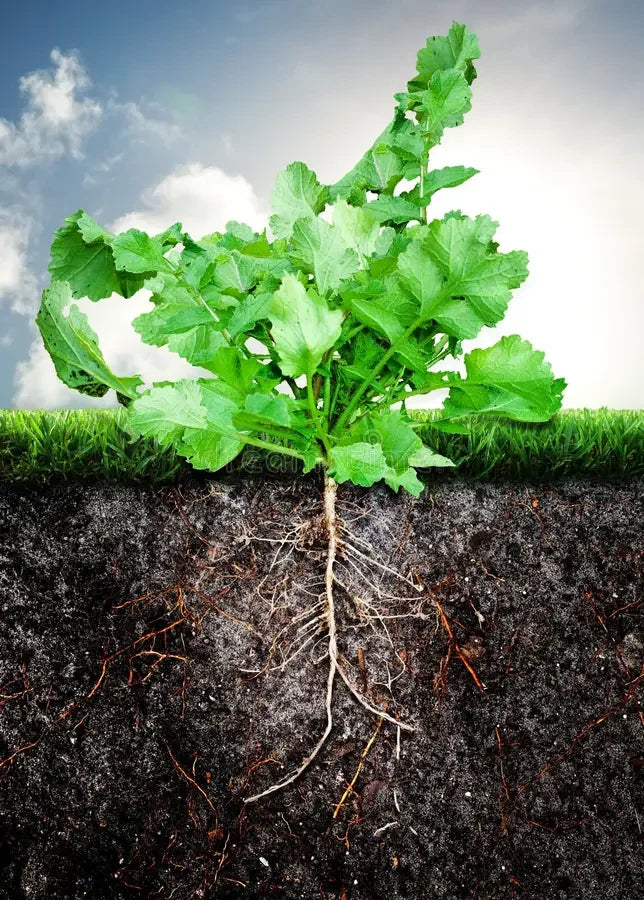
A single teaspoon of good garden soil contains up to a billion bacteria. A billion. Plus fungi, protozoa, nematodes, and a whole web of tiny living things that your plants literally depend on. This is what people mean when they talk about "living soil," and it's not some woo-woo gardening concept—it's real, measurable biology.
Those microbes are doing serious work for your plants:
- Pulling nitrogen straight from the air and converting it into something plants can actually use
- Breaking down organic matter so nutrients become available at the root level
- Extending plant root systems by up to 10x through mycorrhizal networks (think of it as nature's free irrigation system)
- Fighting off soil-borne pathogens and disease
- Improving soil structure so it holds water without drowning roots
Synthetic fertilizers completely bypass all of that. They deliver nutrients in fast-dissolving chemical forms that don't need microbes at all. Which sounds efficient—until you realize that when you stop feeding microbes, they die off. And once that ecosystem degrades, your soil loses its ability to do any of those things on its own.
So you need more fertilizer. And more. Every year. Because the soil has become chemically dependent.
I think about it like this: it's the junk food version of plant nutrition. Fast, effective, and slowly making things worse. (I've got a deeper dive on what living soil actually is and why it matters if you want the full picture.)

"But Lauren, My Plants Look Great."
I hear this every time I bring this up. And genuinely—I believe you! Mine looked great too for a long time.
Green leaves are not the same as a healthy garden. Synthetic fertilizers can make plants look vibrant while the soil underneath gets progressively worse each season. You'll notice it eventually: more disease, more pest pressure, plants that seem harder to keep happy even though nothing obvious changed.
There's also the efficiency problem. Studies consistently show that close to two-thirds of synthetic nitrogen fertilizer never reaches your plants. It leaches out with rain, runs off into waterways, and ends up feeding algae blooms in the creek instead of your tomatoes. So that box isn't just a maybe-concern for your garden—it's actively going somewhere it shouldn't. (If that's something you think about, I wrote more on what actually happens with fertilizer runoff.)
And look—if you're growing vegetables, especially with kids running around the yard, that question of what's in the soil your food is growing in starts to feel a little more personal. That was the thing that got me. Not fear. Just the fact that I knew what was in there and I couldn't unknow it.
For a side-by-side on how organic and synthetic actually compare over time, this post lays it out pretty clearly.
What I Switched To (And Why It's Actually Different)
I spent a lot of time looking for an alternative that wasn't just "less bad." I wanted something that was actively building my soil. And I wanted it to be something I could hand off to my kid without having to Google "safe handling procedures" first.
That's what eventually became Plant Juice.
The ingredient list looks nothing like Miracle-Gro. It starts with worm castings—Class A certified vermicompost, which is honestly one of the most nutrient-dense things you can put in soil. Then fish meal, kelp meal, humic acid, alfalfa, and a blend of beneficial microbes.
We had BiomeMakers—a third-party agricultural lab—run full testing on it. They identified 291 distinct beneficial microbial species in a single bottle. And those microbes aren't just along for the ride. Here's what the lab data actually shows they're doing:
- 80% inorganic nitrogen release — species like Azospirillum and Rhizobium pull nitrogen from the atmosphere and convert it to plant-available forms. Your plants get nitrogen that costs you nothing and hurts nothing.
- 27% phosphorus solubilization — Pseudomonas putida and friends unlock phosphorus that's already locked in your soil but unavailable to plants. Stuff you'd otherwise never get to use.
- 84% auxin production — auxins are plant growth hormones that directly drive root development. More roots = more resilient plants, full stop.
- 56% fungicide activity — beneficial organisms that crowd out soil-borne pathogens before they can cause problems.
Instead of bypassing your soil, you're feeding it. Every application makes the next one work better. That's the opposite of what happens with synthetic fertilizers—and it's the part that still kind of blows my mind.
If you want to go deep on the actual microbial science, this post on probiotic plant food is worth reading.

"My plants were looking a little droopy. After I fed with Miracle Grow that I have been using I did not see any change. I saw Plant Juice on Facebook and thought I'd give it a try. After only one application I must say my plants have perked up nicely. I will continue to use the product."
— Royce M., verified buyer

"I have never had tomato roots grow out of the pot as strong as this. This stuff is amazing—it definitely makes root production much faster than Miracle Grow. I love it."
— Timothy M., verified buyer
Miracle-Gro vs. Plant Juice: The Honest Side-By-Side
| What Matters | Miracle-Gro (Synthetic) | Elm Dirt Plant Juice (Organic) |
|---|---|---|
| Primary ingredients | Urea, ammonium sulfate, potassium chloride | Worm castings, fish meal, kelp, living microbes |
| Nutrients delivered | 3 (N-P-K only) | 50+ micro and macronutrients |
| Soil health over time | Degrades with repeated use | Improves every season |
| Microbial activity | Disrupts soil biology | Adds 291 beneficial species |
| Burn risk | Yes—salt accumulation | Zero burn risk, ever |
| Safe for kids & pets | Use with caution | Yes—people, pets, pollinators |
| Environmental runoff | Significant | Minimal |
| Long-term cost | Need more every year | Need less as soil improves |
Is the Switch Actually Hard? (No. Here's Why.)
My biggest worry when I stopped using synthetic fertilizer was that my garden was going to fall apart during the transition. Spoiler: it didn't.
Plant Juice works just like any liquid fertilizer—2 oz per gallon of water, apply when you water. That's it. No special equipment, no complicated schedule, no learning curve. The only real adjustment is mindset. You stop chasing the fast green hit and start watching for something slower and more satisfying: roots that go deeper, plants that bounce back when it gets hot, soil that actually smells like soil instead of chemicals.
If your garden has been on synthetics for a few years, it might take a few applications before you see the full difference. That's normal—you're rebuilding an ecosystem, not flipping a switch. Most people notice something within the first couple weeks though.
Want to speed up the recovery? Pair Plant Juice with Ancient Soil worm castings. The castings give your soil an immediate biological boost right at the root zone while Plant Juice keeps feeding that biology over time. It's the combination I use in my own garden. I wrote more about why worm castings are so powerful in this post—the science behind them is genuinely cool.

A Word for the Indoor Plant People
For anyone with houseplants, the case for going organic is even stronger. Your plant lives in the same pot of soil indefinitely. There's nowhere for synthetic salt buildup to go—it just concentrates. You've probably seen it: that white crusty layer on the top of the soil, or around the drainage holes. That's salt residue.
More importantly, you're using this stuff inside your home. Your dog is sniffing around the pots. Your kids are touching the leaves and then touching their faces. That context changes how I think about what I want in the mix.
Plant Juice works beautifully for houseplants of every kind—monsteras, fiddle leaf figs, pothos, succulents, tropicals. Same dilution, same application. And for a full guide to feeding indoor plants, this one covers it all.
The Bottom Line
I'm not saying Miracle-Gro is poison. It's been in gardens for 70 years and there are generations of healthy people who grew up eating food fertilized with it. I get it.
But I am saying that "makes plants green fast" and "builds a healthy, self-sustaining garden" are two very different things. And once I understood what synthetic fertilizers actually do to the soil biology that makes gardens thrive long-term—I couldn't justify using them anymore. Not with a kid crawling around the yard. Not as someone who actually understands the chemistry.
The good news is switching is genuinely easy. Two ounces in a watering can. That's the whole routine. Your soil gets better every time you do it instead of worse. And you stop worrying about what you're putting on your family's food.
That's the switch. It's a good one.
Try Plant Juice — Our Organic Alternative to Miracle-Gro
291 verified beneficial microbial species. Zero synthetic chemicals. Zero burn risk.
4.7 stars · 1,453 verified reviews.
Keep Reading
- Living Soil Explained: Why Microbes Matter More Than NPK
- Liquid Organic Fertilizer: Benefits, Types & Application Guide
- What Gardens Using Synthetic Fertilizer Are Missing
- How to Fertilize Plants: A Science-Based Guide to Plant Nutrition
- Microbe Fertilizer: The Science Behind Probiotic Plant Food
- Is Miracle-Gro Organic? What the Label Actually Tells You
- 5 Reasons to Stop Using Synthetic Fertilizers
- Organic vs. Synthetic Fertilizer: Speed, Results & Long-Term Impact
Frequently Asked Questions
What are the ingredients in Miracle-Gro?
Miracle-Gro All Purpose Plant Food contains urea nitrogen, ammoniated phosphate, and potassium chloride as its primary ingredients. It also contains synthetic chelated micronutrients and chemical salts that can build up in soil over time and harm beneficial microorganisms.
Is Miracle-Gro safe for vegetables and edible plants?
Miracle-Gro is labeled for use on vegetables, but it contains synthetic urea nitrogen and chemical salts. Many gardeners who are concerned about what goes on their food—especially if kids are eating from the garden—choose CDFA-certified organic fertilizers instead.
Does Miracle-Gro kill soil microbes?
Yes—repeated use of synthetic salts and chemical nitrogen can disrupt beneficial soil biology over time. Populations of mycorrhizal fungi and nitrogen-fixing bacteria decline, and the soil's ability to cycle nutrients on its own gets weaker each season.
What's a good organic alternative to Miracle-Gro?
Elm Dirt's Plant Juice is one of the most popular organic alternatives out there. It's a living liquid fertilizer with worm castings, fish meal, kelp, and 291 verified beneficial microbial species—verified by third-party lab testing. It feeds the soil biology instead of bypassing it, and it's safe for people, pets, and edible plants.
Is Miracle-Gro bad for the environment?
It can be. Synthetic fertilizers contribute to nutrient runoff into waterways—leading to algae blooms and aquatic ecosystem damage. Studies suggest roughly two-thirds of synthetic nitrogen never reaches the target plant at all. Organic alternatives like Plant Juice have a significantly lower environmental footprint.

Lauren started Elm Dirt after her infant daughter ate dirt from the garden and she realized she had no idea what was in it. As a chemical engineer and mom, she set out to build fertilizers rooted in living soil biology—not synthetic chemicals. Today Elm Dirt products are used by home gardeners, rose champions, and organic growers across the country.