



Do Organic Fertilizers Work as Fast as Synthetic? (Honest Answer)

This might be the question I get more than any other. And I get why people ask—because the honest answer is kind of annoying. It's a "yes, but" and a "no, but" all at the same time, and I'm a chemical engineer so I can't just let that go without explaining what's actually happening.
So here's the real deal. Liquid organic fertilizers can work faster than you'd expect—we're talking 7–14 days. Dry granular organics are slower out of the gate, no question. But here's the thing nobody in the fertilizer industry wants to talk about: by season two, the whole speed conversation flips. Keep reading, because this actually changes how you should think about all of this.
Why Synthetic Feels So Fast (And Why That's Kind of a Trick)
When you dump synthetic fertilizer on your garden and see green growth pop up in three to five days, here's what's actually going on. Synthetic fertilizers are pre-dissolved salt compounds. The second they hit wet soil, they go straight into your plant's roots—no waiting, no microbial help required. Your plant takes a big hit of nitrogen and perks right up. You feel great. You think, "okay, this stuff works."
Here's the part they don't put on the bag.
Nearly two-thirds of those synthetic nutrients never reach your plant at all. They wash out through runoff or get chemically locked up in the soil in forms your plant can't use. So your $15–$20 bottle of Miracle-Gro is actually delivering about $5–$7 worth of effective nutrition. The rest of it is feeding your driveway, basically.
And then it gets worse. Those synthetic salts? They kill beneficial microbes. The exact same microbes that help your plants absorb nutrients, fight disease, and build strong root systems. Every time you apply synthetic fertilizer, your soil gets a little deader. Which means next season your plants need even more fertilizer just to get the same result. It's a dependency loop, and I've heard from so many customers who were stuck in it for years without realizing it.
⚡ Real talk: Synthetic fertilizer is kind of like giving your garden an energy drink instead of actual food. Quick hit, feels great for a minute, then you crash and need another one. Organic fertilizer builds the kind of soil that feeds your plants on its own—and gets better at it every year. More on how this plays out: Synthetic vs. Organic Fertilizers: The Full Breakdown.
So How Fast Do Organic Fertilizers Actually Work?
It really depends on which kind you're using, and I think this is where a lot of people get burned (no pun intended). There's a big difference between liquid organics and dry granular organics, and lumping them together is part of why the myth that "organic is slow" gets passed around so much.
Liquid Organics: Faster Than You'd Think
Liquid organic fertilizers are the ones that genuinely surprise people. Because they're already in liquid form, a lot of the nutrients are partially broken down and ready to go—way more so than something you'd scoop out of a bag. Most people see real results in 7–14 days. Sometimes less.
Our Plant Juice is the best example I can give you. It's a liquid microbial fertilizer with 291 verified species of beneficial bacteria and fungi—we had an independent lab called BiomeMakers test it, and the numbers they came back with were honestly kind of wild:
- 80% of microbial species fix nitrogen — pulling it right out of the air and converting it into forms your plant can actually use
- 27% solubilize phosphorus — unlocking nutrients that were already in your soil but locked up in a form roots couldn't reach
- 84% produce auxin (IAA) — that's a plant growth hormone that drives root development and cell division
- 84% produce exopolysaccharides — these create a protective film around roots that holds moisture and keeps pathogens out
- 56% have antifungal activity — natural biocontrol, built right into the microbial community
That's not marketing copy. That's third-party lab data. Microbes like Flavobacterium, Pseudomonas putida, Comamonas terrigena, and Azospirillum are in there doing actual work—pulling nitrogen from the air, unlocking stuck phosphorus, producing hormones that tell your plant to grow. It's a lot going on in one bottle.
Dry Granular Organics: Yes, They're Slower
Granular organics—bone meal, worm castings in dry form, compost—these take longer. Usually 2–6 weeks before you'll see anything noticeable, because the soil bacteria have to break all that material down first before your plant can use any of it. And they need warmth to do that work efficiently, so cold soil makes everything slower.
So if someone is comparing a bag of granular organic fertilizer to a bottle of Miracle-Gro and saying "synthetic is faster," sure, in that specific matchup they're right. But that's a really unfair comparison. It's like saying surgery is better than physical therapy because surgery works faster. Technically true. Not really the point.
"Tomatoes shot up a foot and half in just a few weeks using the plant juice! Even the slow growing plants like the macadamia nut tree doubled its leaves since using the plant juice!"— Brian B., Verified Purchase
Organic vs. Synthetic: How They Stack Up
| Factor | Synthetic Fertilizer | Liquid Organic (like Plant Juice) | Dry Granular Organic |
|---|---|---|---|
| First visible results | 3–5 days | 7–14 days | 2–6 weeks |
| How long it lasts | Short burst, then done | Fast start + keeps feeding | Slow release, lasts all season |
| Burn risk | High — salt damage is real | Zero | Zero |
| What it does to soil biology | Kills beneficial microbes | Adds 291+ species of good guys | Feeds existing soil life |
| Year over year | Gets less effective — soil degrades | Gets faster and better every season | Gets faster and better every season |
| Nutrient efficiency | ~33% — you're wasting two-thirds | Much higher once mycorrhizae establish | High over the full season |
| Safe for kids & pets? | No — 24–72 hr wait required | Yes — immediately safe | Yes |
| Dependency | Creates it — soil gets needier over time | Breaks it — soil gets more self-sufficient | Breaks it — soil gets more self-sufficient |
The Thing That Changes Everything After Year One
Okay, this is the part I get genuinely excited about because almost nobody talks about it.
In year one with organic fertilizer, yes—you might be waiting an extra week or two compared to synthetic. Fine. I get it, that's annoying when you want to see something happening in your garden right now. But here's what's building underneath the surface the whole time.
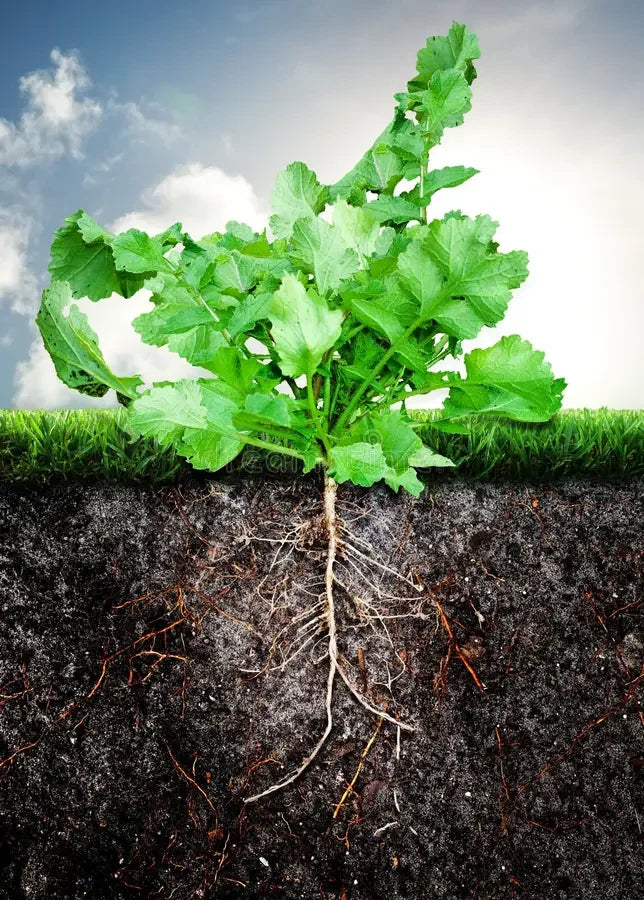
The mycorrhizal fungi in your soil—which synthetic fertilizers wipe out completely, by the way—are creating what I think of as a second root system. This fungal network threads through the soil and extends your plant's reach by up to 10 times. Once it's established, your plant can pull in 20–30x more nutrients than a root on its own can manage. It can hold more water. It can pick up on chemical signals that warn it about pests and disease before they even arrive.
This is why gardeners who've been using organic for two or three seasons usually can't believe the difference. Their soil is doing so much more of the work for them. The gap between organic and synthetic doesn't just close—it reverses. If you want to go deep on how this works, our post on your garden's underground mycorrhizal network is worth reading.

We call this the Avatar Effect—when everything in your soil is connected and working together. Plants, fungi, bacteria, all protecting and feeding each other in this little ecosystem. You can't buy that in a bag of Scotts. You have to build it. But once you do, your garden starts feeling a lot less like work.
I Know Why You're Actually Asking This
You've probably killed plants before. (We all have. Don't feel bad.) Maybe you've tried organic fertilizers that didn't do much and you wondered if you were just wasting your money. Or you're staring at your tomatoes right now and you need results this summer, not in some theoretical future garden. That's real and that's fair.
Here's what I tell people: start with a liquid organic fertilizer and you'll close most of the speed gap immediately. You'll see leaves greening up, new growth pushing out, plants that look like they actually want to be alive—all within a couple of weeks. And you'll have zero risk of burning anything, which I can't say the same for that blue powder everyone's mom used to use.
A customer named Suzanne tried Plant Juice on her hibiscus for the first time and could not believe how fast it filled out. Brian's tomatoes shot up a foot and a half in a few weeks. A macadamia nut tree—one of the slowest-growing plants out there—doubled its leaves. These aren't cherry-picked outliers. This is just what happens when you give soil biology what it actually needs.
"I have never seen my hibiscus grow so fast and full in a short amount of time when I used plant juice for the first time. This product is absolutely amazing!"— Suzanne M., Verified Purchase
The Safety Thing Is Actually a Big Deal
I know "safe for kids and pets" sounds like marketing fluff, but hear me out—because when you actually look at what you're supposed to do after applying synthetic fertilizer, it gets kind of alarming.
Those concentrated salt compounds can be toxic to dogs and cats if they ingest them. The recommended waiting period before kids and pets can be back on treated lawn or garden areas is usually 24 to 72 hours. If you have a dog who eats grass or kids who kick off their shoes the second they go outside, you know that waiting period is basically a fantasy.
With Plant Juice—CDFA certified organic, no synthetic chemicals, nothing that needs a hazmat warning—you can spray in the morning and let the whole family loose in the yard that afternoon. That's not a small thing. And if you're growing vegetables? You're eating what goes into that soil. I think about that a lot as a mom.
The runoff question is real too. Synthetic fertilizer doesn't just affect your garden—it washes into waterways and causes all kinds of downstream problems. Switching to organic is better for your yard and honestly better for everything downstream of it. More on this in our piece about lawn care and pet health.
💡 One thing to keep in mind: If you're switching from synthetic to organic, your soil biology is probably pretty depleted. Give it one full season. That first year might be slower while the microbial community rebuilds—but by year two, you're going to wonder why you ever did it any other way. Our post on building healthy soil that lasts walks through what that transition actually looks like.

How to Actually Get Fast Results with Organic Fertilizer
If you want to close the speed gap as much as possible from day one, here's exactly what I'd do. No fluff, just what works.
- Start with a liquid microbial fertilizer. Plant Juice is where I'd begin. One ounce per gallon of water, apply every 7–14 days. You should see something happening within two weeks.
- Get some worm castings into your soil. Ancient Soil or straight Worm Castings—either one. They're packed with slow-release nutrients and billions of living microbes that start working the second they hit your soil and keep going for months.
- Keep things consistently moist. Microbes need moisture to do anything. Bone-dry soil is like sending your workers home. Water regularly and the biology stays active.
- Don't try to mix synthetic in "just to speed things up." I've heard this one a lot. Those synthetic salts will kill the exact microbes you're trying to establish. Pick a lane.
- Be patient with the transition if your soil is depleted. Especially if it's been through years of synthetic fertilizer. It wakes back up—it just needs a few weeks to remember what it's supposed to do.
Honestly, the Plant Juice plus Ancient Soil combination is what I'd start anyone on. The liquid gets fast-acting microbial life into your root zone immediately, and the worm castings rebuild the soil structure underneath and keep slow-releasing nutrients for months. They work together in a way that individual products just don't.
Want to try organic fertilizer that actually works fast?
Plant Juice has 1,600+ five-star reviews and a 180-day money-back guarantee. If it doesn't work for you, you pay nothing.
People Also Ask
Do organic fertilizers work as fast as synthetic fertilizers?
Not always right out of the gate—but the gap is a lot smaller than most people expect. Liquid organic fertilizers like Plant Juice can show results in 7–14 days. And here's what nobody talks about: the longer you use organics, the faster your soil responds. Synthetics work in reverse—they degrade your soil biology every season, so you end up needing more and more just to get the same results.
Why do synthetic fertilizers work faster?
They're basically pre-dissolved salts. They go straight into plant roots the second they hit wet soil—no microbial help needed. Your plant perks up fast. The problem is nearly two-thirds of those nutrients wash right out through runoff and never make it to the plant. And every application kills the beneficial microbes your plants actually depend on for long-term health.
What are the fastest-acting organic fertilizers?
Liquid organic fertilizers, by a wide margin. Elm Dirt's Plant Juice has 291 verified microbial species and most customers see real results in 7–14 days. Worm casting teas are another solid fast option. Dry granular organics take longer—usually 2–6 weeks depending on soil temperature and moisture.
Can organic fertilizers burn plants?
Nope—and honestly this is one of my favorite things about them. Organic fertilizers release nutrients slowly in forms plants can take up as needed. You can't burn your plants with worm castings or Plant Juice even if you go heavy. Synthetic fertilizers are completely different—those concentrated salts can scorch roots and leaves fast if you're not careful.
Do organic fertilizers get faster over time?
Yes, and this is the part I wish more people knew. Every season you use organic fertilizer, you're building soil biology—microbes like Azospirillum and Pseudomonas putida multiply, fungal networks grow, nutrient cycling gets more efficient. By your second or third season, plants fed organically almost always outperform synthetic-fed plants. The soil does more of the work for you.
Is it safe to use organic fertilizer around kids and pets?
Yes. Plant Juice is CDFA certified organic—no synthetic chemicals, nothing that needs a warning label. You can spray it and let the dog out five minutes later. With synthetic fertilizers you're typically waiting 24–72 hours before kids and pets can be back on treated areas. For families with little ones or animals running around, that difference is a pretty big deal.
The Short Version
Synthetic fertilizers are faster out of the gate. That's just true and I'm not going to pretend otherwise. But you're basically borrowing against your soil's future every time you use them. You get a quick green flush, waste two-thirds of what you paid for, and slowly make your garden more dependent on chemicals to function at all.
Liquid organic fertilizers close most of that speed gap right away. And then something quietly cool starts happening: the longer you stick with them, the better and faster your garden responds—because you're actually building something in the soil instead of just feeding it hand to mouth. Season after season, billions of microbes doing their jobs, making the whole thing easier.
If you've been thinking about making the switch and just haven't pulled the trigger, try one season. We back Plant Juice with a 180-day money-back guarantee because we know what it does and we want you to see it for yourself. No risk in that.
More reading if you want it:
- Synthetic Fertilizers vs. Organic Fertilizers: The Full Breakdown
- Building Healthy Soil That Lasts
- Living Soil Explained: Why Microbes Matter More Than NPK
- How to Fertilize Plants: A Science-Based Guide
- Liquid Organic Fertilizer: Benefits, Types & How to Use It
