



How Microbes Protect Your Garden From Disease Without a Single Spray

Beneficial soil microbes protect plants from disease by crowding pathogens off the roots, releasing natural antifungal compounds, locking away the iron disease fungi need, and switching on the plant's own immune system. None of that comes out of a bottle you spray. You grow it — by feeding your soil and laying off the harsh chemicals.
For about six years, my whole approach to plant disease was a spray bottle and a bad attitude.
Spot on a leaf? Spray it. Fuzzy white stuff on the squash? Spray that too. I had three different bottles under the deck stairs and I couldn't have told you what was in any of them.
What I could have told you is that I was out there every weekend doing it again.
Then I got curious about what was actually living in the dirt I kept dumping this stuff onto. And I'll spare you the eighteen months of reading, but here's where it landed me: the best disease protection your plants will ever get isn't something you put on top of them. It's already down there. Been down there the whole time, working for free, and I'd been killing it every Saturday.
What's in this guide
The Real Reason Plants Get Sick
Nobody ever sat me down and explained this part, so let me do it for you.
Plant disease usually isn't bad luck. It isn't one unlucky spore that happened to drift into your yard on a Tuesday.
Here's the thing — those disease organisms are already there. All of them. Every day. Your tomatoes are swimming in fungal spores right now, and have been since the day you put them in the ground. So the real question isn't why your plant got sick. It's why it didn't get sick sooner.
The answer is that in decent soil, somebody's already holding the ground.
Which means the trouble starts when that soil goes quiet. And an awful lot of yards have gone quiet without anyone noticing, because dead soil looks exactly like living soil from the kitchen window.
Usually it's some combination of:
- Synthetic fertilizer, year after year. It feeds the plant directly and skips the soil entirely, so the microbes that used to do that job go hungry and thin out. Your plant gets the meal. Your soil gets nothing.
- Fungicides and pesticides. These are the big one. They don't check ID at the door.
- Bare, baked, compacted ground. Nothing going back in, nothing covering it up.
- Hard tilling every spring. Fungal networks take years to build and about forty seconds to shred.
- Chlorinated tap water and not much else, season after season after season.
Take out the living crew and you've left the front door open. The disease didn't get stronger. There's just nobody home anymore.
If you want to go further down this road, I wrote a longer piece on why healthy soil is the real secret to garden success, and there's a straight side-by-side on living soil vs. sterile soil if you like seeing it laid out. Not sure which one you've got? Try 5 signs your garden soil needs help — number three surprised me.

Beds, borders, lawn — doesn't matter. Living soil defends whatever you put in it.
Meet the Microbes That Fight Disease For You
So who's actually on this crew?
This is the part I get excited about, so bear with me. We sent our Plant Juice off to a lab called BiomeMakers for a full genetic workup — not a guess, an actual sequencing of everything alive in the bottle. They came back with 291 different microbial species. I sat with that report for a long evening.
And what got me wasn't the number. It was how many of them weren't there to feed the plant at all. They were there to defend it.
A few of the ones I'd introduce you to first:
- Pseudomonas putida — the single most abundant organism in our whole sample, and honestly the one I'd want on my side. It parks itself on the root, eats the food and takes the space that a pathogen was hoping to use, and puts out compounds that knock fungal invaders back. Neighborhood watch, basically.
- Pseudomonas fluorescens — if you go read the biocontrol research, this is the organism on nearly every page. Decades of it. And it turned up in our bottle without us ever setting out to put it there, which tells you something about what happens when you let real soil biology do its thing.
- Trichoderma — a fungus that hunts other fungi. It finds a harmful fungal thread, coils around it, and digests it. I'm not being cute, that's the actual mechanism, and there's footage of it if you ever want to lose an hour.
- Lysobacter — quiet, unglamorous, dissolves the cell walls of things that would hurt your plant. We found four different Lysobacter species in there.
- Penicillium — yes, that family. Same one that changed medicine. Down in the root zone it's running a smaller version of the same play.
- Streptomyces — this genus has given us more antibiotics than any other on the planet. Now it's doing it for your tomatoes.
- Bacillus species — tough little spore-formers. They make their own antibiotic compounds and, more interestingly, they nudge the plant into waking up its own defenses.
No one of these is the hero. That's sort of the point — you get seven or eight overlapping specialists covering for each other, which is a thing no bottle of one active ingredient has ever managed to do.
How They Actually Protect Plants, No Spray Needed
Fine, but how? A bacterium doesn't have hands.
Four tricks. All of them happening at the root, all of them at once.
1. They take up all the room
Simplest one, and probably the most important. A pathogen needs somewhere to land and something to eat. If the good guys got there first and used up both, there's nowhere to sit down.
The textbooks call this competitive exclusion. I think of it as a full parking lot.
2. They make their own medicine
A lot of these organisms manufacture antifungal and antibiotic compounds and release them straight into the root zone. It's genuinely a chemical fight down there — it's just that your side is producing the chemicals on site, for free, and nobody has to wear gloves.
3. They lock up the iron
This one's my favorite bit of strategy in the whole system. Most disease fungi need iron to mount an attack. They can't do much without it.
So the beneficial microbes go grab it first. Our lab report shows 82% of the species in Plant Juice produce siderophores — molecules whose entire job is to find loose iron and hold onto it. By the time a pathogen shows up hungry, the shelves are bare.
4. They talk the plant into defending itself
And this is the one that actually changed how I think about gardening.
When friendly microbes settle in around the roots, the plant notices. It responds by turning up its own immune defenses — not just at the roots, but throughout the whole plant, leaves included. A microbe two feet underground makes the leaves harder to infect. Something like a vaccine, if you want a rough analogy.
Scientists call it induced systemic resistance. The major review on it names Pseudomonas, Bacillus and Trichoderma by name — the same organisms sitting in our lab report, which I did not expect the first time I read it. A second review pins down siderophores and salicylic acid as the signals that kick it off. We went deeper on this in how bacteria boost plant immunity.
Stack those four together and you've got a plant that handles this on its own. You're not scouting for problems, you're not on a spray schedule, you're not keeping the grandkids off the patio for two days. The plant's got a security team and it pays them in compost.

Tomatoes and basil, no sprays. Everything interesting here is happening under the mulch where you can't see it.
Spray Routine vs. Living Soil, Side By Side
I lived in the left column for years. Took me too long to move over.
| The spray routine | Living soil defense | |
|---|---|---|
| When it works | After you've spotted the problem | Before it ever starts |
| Your Saturday | Scouting, mixing, spraying, repeat | Pour it in when you water |
| Coverage | Wherever the spray landed | Whole plant, roots through leaves |
| Effect on soil | Kills the good with the bad | Builds the population every season |
| Kids and pets | Re-entry intervals, keep everybody off | CDFA Certified Organic, no waiting |
| Next season | You start a little further behind | You start a little further ahead |
That bottom row is what finally got through to me. Every season of spraying made the next season of spraying more necessary — I was on a treadmill and I'd built it myself. Living soil runs the other direction. It compounds for you instead of against you.
Worth a read if you're still weighing it: organic vs. synthetic fertilizer and what the soil health research actually found, and how long pesticides really stick around in your soil. That second one is the article that made me clean out under the deck stairs.
How to Build This Defense Crew in Your Own Garden
Good news is you don't need a lab, a degree, or a soil test to start.
You mostly need to quit killing the crew and start feeding it. Five things.
- Put down the fungicides. Synthetic fungicides and pesticides can't tell a helpful microbe from a harmful one, so they take both. Worth knowing that a lot of garden center plants come home already treated — that one still bugs me.
- Feed the soil, not just the plant. Compost and worm castings give your microbes somewhere to live and something to eat. Our Ancient Soil castings run $29.95, and if you're new to the whole idea, here's what worm castings actually are.
- Add the microbes straight in. Fastest route by a mile. Plant Juice starts at $19.95, it's CDFA Certified Organic, and it's got those 291 species in it — so you're pouring the defense crew right where the roots can pick them up. Every other watering is plenty.
- Cover the ground. Couple inches of mulch. Microbes hate baking as much as you do.
- Ease up on the tiller. No-dig gardening lets the fungal networks build year over year instead of starting from scratch every April.
Do those and you stop fighting disease. You're preventing it — the way it's been getting prevented since long before any of us had a garden center to drive to.
Now, if you've already got something going on out there — and this time of year, plenty of folks do — start here while the soil catches up: identifying common plant diseases, organic powdery mildew treatment, stopping damping-off in seedlings, and the organic fix for blossom end rot.
Want the wider view? Here's how beneficial microbes help plants grow generally, and the mycorrhizal network that ties the whole underground thing together.
Real Gardeners, Real Results
I'd rather you hear it from them than from me.
Linda W.
The plant that was in my granddaughters room, got some kind of a disease or something was going on with it, lost most of its leaves, and my granddaughter was ready to throw it away, and I was bound and determined to save it. So you can see from the video That after I started using El dirt the plant fertilizer that it has lots of new growth and one steam got so tall almost to the ceiling and I wouldn't want it that tall so I cut off one of the main stands and it already has new growth. I've also used the bloom dirt and my plants thrive

Tracy B.
I bought this because I had rescued some plants and trees from my workplace that needed some love, some extra attention and these poor plants seemed stressed. I brought them home and I began treating them with this amazing product! Within days they perked up. They began new growth previously unseen. What appeared to be plants on their last legs were nearly twice the size within a month, healthy, vibrant and full. The growth and blooms that came upon bare stalks of a barely breathing plant became full and lush. I have a neighbor who had a tropical that was struggling and I treated it and within the week it was blooming more than it ever had before. It is an amazing product and you will notice within the week of the first treatment. Unbelievable! Beyond satisfied with this product.
Lisa C.
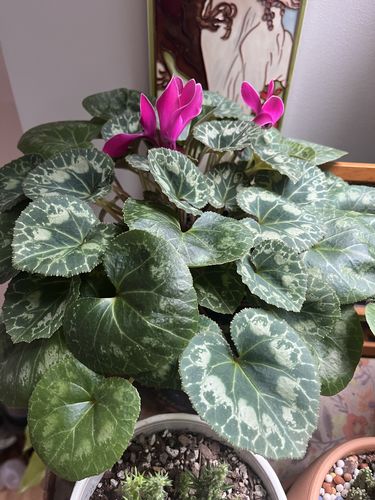
I give all my indoor plants (over 175 plants) & outdoor gardens Elm Dirt Plant Juice. My exotic, succulents & cactuses receive a weekly watering with the juice. Every plant is pushing new growth & is healthy thriving. This Cyclamen has been receiving weekly (as directed) waterings. She has flowered recently & I am delighted how healthy she has progressed. I advise all my friends & plant community by this weekly routine. I've also had a recently repotted well established fairy castle cactus that I nurtured with plant juice watering & she is revived, healthy & going strong. Thank you Elm Dirt for your continued commitment of sharing your knowledge & magic with us consumers. I will continue to give my plants the opportunity to thrive to the best of their potential by giving them the cleanest, healthiest nourishment from Elm Dirt Plant Juice.
Charlotte P.
I cleared the rich ground and set out to have a butterfly & bee garden. After 10 days or so they all seemed happy; still, they looked very tired. The "cat whiskers" especially; it hadn't had any bloom since planting. I gave all these shown a healthy dose of Elm Juice...They're fortified! What a joy to behold how they've responded. Worm castings are superior support for any green growth; they're also a ton of fun-hobby to raise (not for those seeking instant gratification). I once owned a "worm farm" .... fascinating little creatures that exist to produce nothing but good stuff. I recommend Elm Juice. You have yourself a mighty fine day. Thank you, Charlotte

Rated 4.65 out of 5 across 1,793 verified Plant Juice reviews.
Frequently Asked Questions
Can microbes really stop plant disease without spraying?
They can, and they've been doing it a lot longer than we've had spray bottles. The good microbes crowd out disease organisms, make their own antifungal compounds, lock away the iron pathogens need, and switch on the plant's own defenses. All of it running around the clock, none of it on your to-do list.
Which microbes protect plants from disease?
The best-studied are bacteria like Pseudomonas putida, Pseudomonas fluorescens, Lysobacter and Streptomyces, plus fungi like Trichoderma and Penicillium. Every one of those was verified in our Plant Juice by the lab at BiomeMakers — I didn't pick that list off a website, it came off our own report.
Does synthetic fertilizer kill soil microbes?
Not instantly, but yes, over time. Repeated high-salt synthetic feeding thins out microbial diversity and activity, and fungicides and pesticides take the beneficial organisms right along with whatever you were aiming at. Your plant still eats. Its defense system just gets a little weaker each year, and you won't notice until something goes wrong. More on the mechanics in the science behind microbe fertilizer.
How do I add beneficial microbes to my garden?
Compost and worm castings, a living biofertilizer like Plant Juice, mulch on top, and no more harsh chemicals. That's really the whole list. The microbes handle the rest without any supervision from you.
How long before I see a difference?
They colonize the root zone within days. Most folks tell us they notice plants perking up somewhere in that one-to-three-week stretch. Building soil that genuinely shrugs disease off on its own takes a season or two — I won't pretend otherwise — but you'll see signs long before you get there.
Is Plant Juice safe around kids and pets?
It is. CDFA Certified Organic, made from beneficial microbes and natural ingredients, no synthetic chemicals. That's not a marketing angle for me, that's the entire reason this company exists — my six-month-old ate a fistful of our backyard and I couldn't answer my own question about what was in it.
Let Your Soil Do the Defending
The spray-and-pray years had me working harder than my garden ever did.
Handing the job back to the microbes got me healthier plants and my Saturdays back, and I'd take that trade again tomorrow. The bottles under the deck stairs are long gone.
If you want to get that crew working in your own beds and pots, easiest place to start is right here.
Shop Plant Juice — from $19.95
Your plants have a security team waiting on you. Give them a soil worth living in and get out of the way.
Sources: BiomeMakers Microbiome Analysis Report #CUX005 (Elm Dirt Plant Juice, 29 May 2024). Pieterse et al., "Induced Systemic Resistance by Beneficial Microbes," Annual Review of Phytopathology (PubMed). Van Loon et al., "Systemic Resistance Induced by Rhizosphere Bacteria," Annual Review of Phytopathology (PubMed).

Lauren Cain
Founder & Chemical Engineer · Elm Dirt, Grandview, Missouri
Lauren started Elm Dirt after her 6-month-old daughter grabbed fistfuls of dirt and ate them. As a chemical engineer and a mom, she couldn't just shrug it off, so she dug into the science of what was really in garden soil. That rabbit hole led her to build a fertilizer line around beneficial microbes instead of synthetic chemicals. Today Elm Dirt's products are used by home gardeners, rose show champions, and organic growers across the country.