



Orchid Fertilizer Timing: Why Most People Get It Wrong (And When to Actually Feed)

Fertilize orchids while they are actively growing new roots, leaves, or a flower spike. For most home orchids that means spring through fall, using the "weakly, weekly" rule: a diluted feeding about once a week, always onto damp roots.
Keep feeding through September and October. Moth orchids (Phalaenopsis) start next season's flower spikes during cool fall nights and keep growing slowly all winter, so reduce feeding in winter instead of stopping. The other key window is right after blooming, when the orchid grows the roots and leaves that carry its next flowers.
There's a moment every orchid grower waits for, and it's small enough to miss if you aren't paying attention. A little green nub pokes out from between two leathery leaves, and at first you figure it's just another root, until you notice the tip is flattened out like a tiny mitten instead of round and silvery.
That's a flower spike.
Whether you see one this winter depends a lot on the next six weeks or so, which is exactly why I wanted this post out in September instead of January.
Orchids have a reputation for being fussy. I've never really bought it (and as a chemical engineer, I'll admit a plant that runs on a predictable schedule is my favorite kind of plant). They just eat on a different clock than your pothos does, and once you know the clock, feeding them turns into one of the easier chores in the house.
What's in this guide
Why Orchids Eat Differently Than Your Other Houseplants
Most orchids you bring home from the grocery store or garden center are epiphytes, which is a fancy way of saying they don't grow in dirt at all in the wild. They hang onto tree bark up in the canopy, and whatever food they get shows up a little at a time, rinsed off the branches above them by passing rain.
Sippers, not big eaters.
That one fact explains almost everything about how to feed them:
- Strong doses scorch them. Roots built for a faint drizzle don't know what to do with a full-strength drench, and the tips go brown and crispy.
- Dry roots burn the easiest, since they grab whatever hits them first, salts and all.
- How much food? Match it to growth: more when the plant is pushing new leaves, a lot less when it's just sitting there looking pretty.
- And the bark itself has almost no food in it. It's there so roots can breathe and drain, which we get into in our post on orchid bark vs. regular bark.

Bark keeps orchid roots airy and happy. Food, though? That part's on you.
When to Feed Orchids: A Stage-by-Stage Guide
Put the calendar down for a minute and look at the plant. What it's doing tells you what it needs.
| If your orchid is... | Feed it? | Why |
|---|---|---|
| Growing new roots or leaves (spring to summer) | Yes, weakly and weekly | Peak growth. The plant uses the most food now. |
| Feeling cooler fall nights (September to October) | Yes, keep going | Moth orchids are setting up next season's flower spikes. |
| Pushing a flower spike | Yes, lightly | The spike and buds are still being built. |
| In full bloom | Light feeding is fine | The flowers are already formed. This is not the key window. |
| Just finished blooming | Yes, steadily | The plant is growing the roots and leaves that support its next bloom. |
| Growing slowly in winter | Reduce | Moth orchids still want a lower rate. Many cattleyas want little or none. |
Winter is where the rules split by orchid type. The American Orchid Society says moth orchids keep growing through winter and still want food at a lower rate, while most cattleyas need little or none and soft-cane dendrobiums are happier with nothing at all until spring.
Not sure which one you've got?
Odds are good it's a moth orchid, the kind with flat, leathery leaves fanning out from the base and a long arching stem of flowers that looks like a row of butterflies landed on it, because that's what nearly every store sells. For the rest of your houseplants heading into the slow season, our winter indoor plant care guide and houseplant fertilizer guide will get you through.
Why September Is a Big Deal for Orchids
Moth orchids decide when to bloom based on temperature a lot more than anything on the calendar. According to the AOS, several weeks of nights around 55°F in autumn is what kicks off new flower spikes.
Which means right now.
Around Kansas City, September is usually when evenings finally start cooling off, and plenty of the country isn't far behind. If your orchids spent the summer out on a porch or under a shade tree, University of Maryland Extension suggests bringing them in once evening temperatures dip into the fifties. Already inside? Parking them near a window that runs a little cooler at night gives them the same nudge without any fuss.
Keep feeding through fall. A moth orchid building a flower spike needs steady, gentle food, not a September shutdown.
A few things that help this time of year:
- Keep weakly, weekly going right through October.
- Cooler nights are good. Cold glass isn't. If leaves are touching the window, scoot the pot back an inch, and keep it clear of the heat vent once the furnace starts kicking on.
- Look for that mitten-shaped tip. Spikes usually show up in early winter in most of the country, so don't fret if November comes and goes with nothing.
- Once buds form, leave the plant be. I know it's tempting to move it front and center on the table, but sudden temperature swings can make buds drop before they ever open.

Those flower sprays you'll enjoy in late winter get their start on cool fall nights.
The "Weakly, Weekly" Rule
If you only remember one orchid phrase, make it this old growers' saying.
Weakly, weekly.
It sounds like somebody made a typo on a plant tag and nobody ever bothered to fix it. But a diluted feeding about once a week while the plant is growing does more good than one big dose a month, and the AOS points out that dilute feedings given more often are a lot closer to what epiphytic orchids get out in the wild.
For conventional salt-based orchid food, the New York Botanical Garden recommends about a quarter of the label strength every time or every other time you water. With a gentle microbial feed like Plant Juice, I'd still mix orchids on the light side. Call it the engineer in me, but I would rather start low and adjust than start high and spend a month apologizing to a plant.
Our dilution calculator does the math, so nobody has to squint at the lines on a measuring cup at the kitchen sink. And if you've ever wondered where "too much" actually starts, our guide to how much fertilizer is too much covers the warning signs.
The Feeding Window Right After Blooming
When the last flower drops, it's awfully tempting to slide the orchid to the back of the plant shelf and forget about it for a few months. No judgment here. A pot of leaves with a bare stick poking out of it isn't much to look at.
But that quiet stretch is when the plant goes right back to work. It just poured a huge amount of energy into those flowers, and now it's growing the new roots and leaves that will hold up the next spike, so the feeding you do in these plain green months is really what pays for next year's blooms.
So don't quit on it now.
- Stay with weakly, weekly as new roots and leaves come in.
- That old spike, once it turns brown or yellow, can come off. Growers at the NYBG recommend cutting the spike back after flowering so the plant isn't spending energy on it.
- Roots crawling over the rim, or bark gone soft and crumbly like cereal left in the bowl too long? Good time to repot, and our orchid success guide walks you through it.

The flowers you get next year are built in the plain green months after this year's show.
How to Feed Orchids Without Burning the Roots
Those silvery roots hanging out over the edge of the pot aren't a mess you need to tuck back in. They're how the orchid drinks.
Mist them and you can watch them turn from silver to green as they soak it up, which is about the most satisfying thing an orchid does besides bloom, and it's the reason a gentle orchid fertilizer spray fits so naturally alongside your regular watering.
The routine is pretty simple:
- Water first. Damp bark, never bone-dry roots.
- Mist the aerial roots and leaves with Orchid Mist, especially the roots climbing out of the pot. (Our orchid foliar feeding guide goes deeper on misting if you want the details.)
- Rather pour? A light mix of Plant Juice through the pot on watering day works too. Just let it drain all the way out.
- About once a month, run plain water through to rinse out salt buildup. Our guide to flushing potted plants explains why it matters.
- Mist in the morning so leaves are dry by dinnertime, and try not to let water pool down in the crown where the leaves meet.
A microbial organic feed is a lot more forgiving than straight fertilizer salts. It will not, however, save an orchid that's sitting in soggy bark, and I'd rather tell you that now than have you find out in March. Orchid roots need air as much as they need food, so let the pot drain every single time.

Mist the roots and watch them go from silver to green.
What's Doing the Work Underneath
Okay, the nerdy part. I kept it short, promise.
Start with the roots. That spongy white coating on them is called velamen, and in a 2013 study in Oecologia, researchers found velamen soaks up nutrient solutions within seconds and has a remarkably efficient uptake system when nutrient levels are low. In other words, orchids were built for weak feedings a very long time before anybody came up with a catchy phrase for it.
Then there's the microbes. Plant Juice carries 291 microbial species verified by DNA testing, and there's a couple worth knowing about if you grow orchids:
- Pseudomonas putida is one of the most abundant bacteria in the bottle and a well-studied root partner. We gave it a whole post of its own.
- Sphingomonas likes to live on healthy leaves. In one lab study, plant-dwelling Sphingomonas strains protected leaves from a bacterial disease, probably by eating the bad guys' lunch before they could get to it. That was a small model plant in a lab, not an orchid on your windowsill, so take it for what it is. Still a nice neighbor to have on a plant you mist. More in our Sphingomonas spotlight.
- In DNA analysis, 84% of the species in Plant Juice carry the genetic potential to produce auxin, the plant hormone behind new root growth.

You feed the orchid. A few hundred microbial species handle the unglamorous part.
That's the part I like best. You're filling a spray bottle on a Sunday morning, and underneath it there's a few hundred species doing work you'll never see. You're not doing it alone. If you're curious how we test for all of it, it's laid out on the science behind our products.
Real Gardeners, Real Orchids
I'd rather you hear it from them than from me.
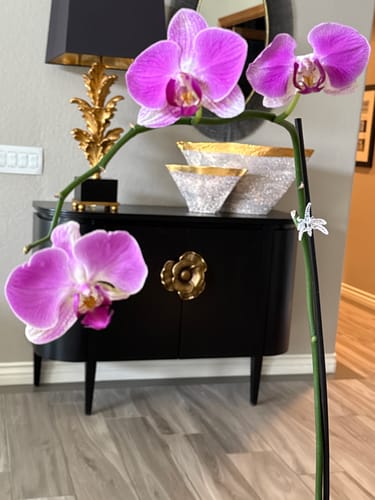
Suzanne K.
My orchids are 3 months old and I'm trying to make their bloom last as long as possible. I believe the Orchid Mist has contributed to that! Very happy!
Sharon P.
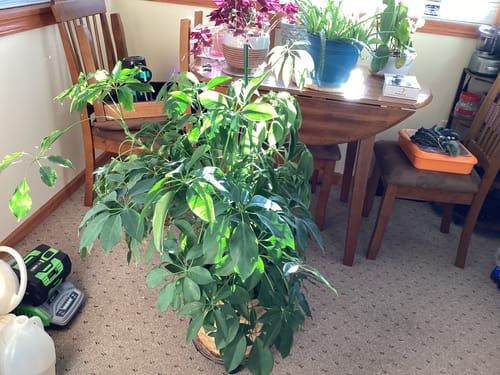
I love the Plant Juice and the Bloom Juice! All of my plants are flourishing as never before. As you can see, my orchid has just exploded and my schefflera has grown as well! I would definitely recommend to others and have recommended to family.
Sylvia H.
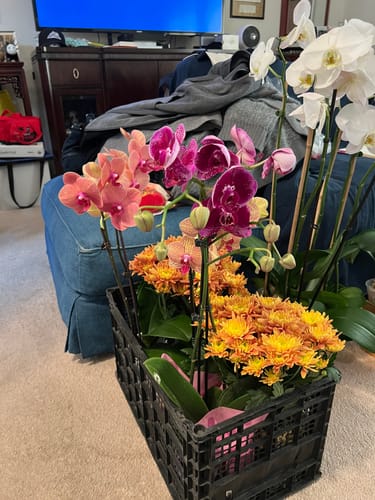
The orchids are happier, producing new flowers
I’m pleased with the product in general
Debbie E.
I have been using
Elm Dirt for about two years. My houseplants have never looked better! I’ve had orchids that I couldn’t get to bloom. After some TLC and Elm Dirt in distilled water they have all finally bloomed. I recommended it to my SIL and she lives it too!
Thank you!
Plant Juice is rated 4.65 out of 5 across 1,793 customer reviews. Orchid Mist is rated 4.6 out of 5 across 10 reviews.
Frequently Asked Questions
When should you fertilize orchids?
Fertilize orchids while they are actively growing new roots, leaves, or a flower spike, which for most home orchids is spring through fall. Moth orchids keep growing slowly in winter, so feed them at a lower rate instead of stopping. Always apply fertilizer to damp roots, never dry ones.
How often should I feed my orchid?
Follow the "weakly, weekly" rule: a diluted feeding about once a week during active growth, with a plain-water flush about once a month. Feed less often in winter. Frequent light feedings are safer for orchid roots than occasional strong ones.
Should I fertilize orchids in the fall?
Yes. Moth orchids (Phalaenopsis) start new flower spikes after several weeks of cool autumn nights around 55 to 60°F. Keep gentle, regular feeding going through fall to support spike and bud development.
Should I fertilize my orchid while it is blooming?
Light feeding during bloom is fine, but it is not the most important window because the flowers are already formed. Steady feeding after blooming matters more, since the orchid is growing the new roots and leaves that support its next flower spike.
Does orchid fertilizer spray work?
Yes. Orchid aerial roots are covered in a spongy tissue called velamen that soaks up water and dissolved nutrients within seconds. A gentle foliar spray on the aerial roots and leaves is an effective, low-risk way to feed orchids, especially those growing in bark, which holds very little nutrition.
Can fertilizer burn orchid roots?
Yes. Strong fertilizer, or fertilizer poured onto dry roots, can burn orchid root tips. Water first, use a diluted or gentle organic feed, and flush the pot with plain water about once a month to clear salt buildup.
Feed on Their Schedule, Then Enjoy the Show
Orchids aren't hard, they just keep their own hours.
Feed them weakly and weekly while they grow, and keep it going through these cool fall nights and the plain green months after bloom instead of shutting everything down along with the vegetable garden. Do that, and one of these gray winter mornings you're going to walk past the windowsill with your coffee and spot a little green mitten poking out between the leaves.
Where to go next
- Get the full picture in our natural orchid success guide.
- Repotting this fall? Start with why orchids need the right bark and grab some Douglas fir orchid bark.
- Join our email list for one small growing win in your inbox each week. When that first spike shows up, hit reply and send us a photo. We love those.
Sources
- American Orchid Society: Fertilize Weakly Weekly
- American Orchid Society: Phalaenopsis Culture Sheet
- American Orchid Society: Phalaenopsis Spiking
- University of Maryland Extension: Care of Phalaenopsis Orchids
- New York Botanical Garden: Phalaenopsis Research Guide
- Zotz & Winkler (2013), Aerial roots of epiphytic orchids: the velamen radicum and its role in water and nutrient uptake, Oecologia
- Innerebner, Knief & Vorholt (2011), Protection of Arabidopsis thaliana against leaf-pathogenic Pseudomonas syringae by Sphingomonas strains, Applied and Environmental Microbiology

Lauren Cain
Founder & Chemical Engineer · Elm Dirt, Kansas City
Lauren started Elm Dirt after her 6-month-old daughter grabbed fistfuls of backyard dirt and ate them. As a chemical engineer and a mom, she couldn't just shrug it off, so she dug into the science of what was really in garden soil. That rabbit hole led her to build a fertilizer line around beneficial microbes instead of synthetic chemicals. Today Elm Dirt's products are used by home gardeners, rose show champions, and organic growers nationwide.